

by PAUL SOUTHWELL
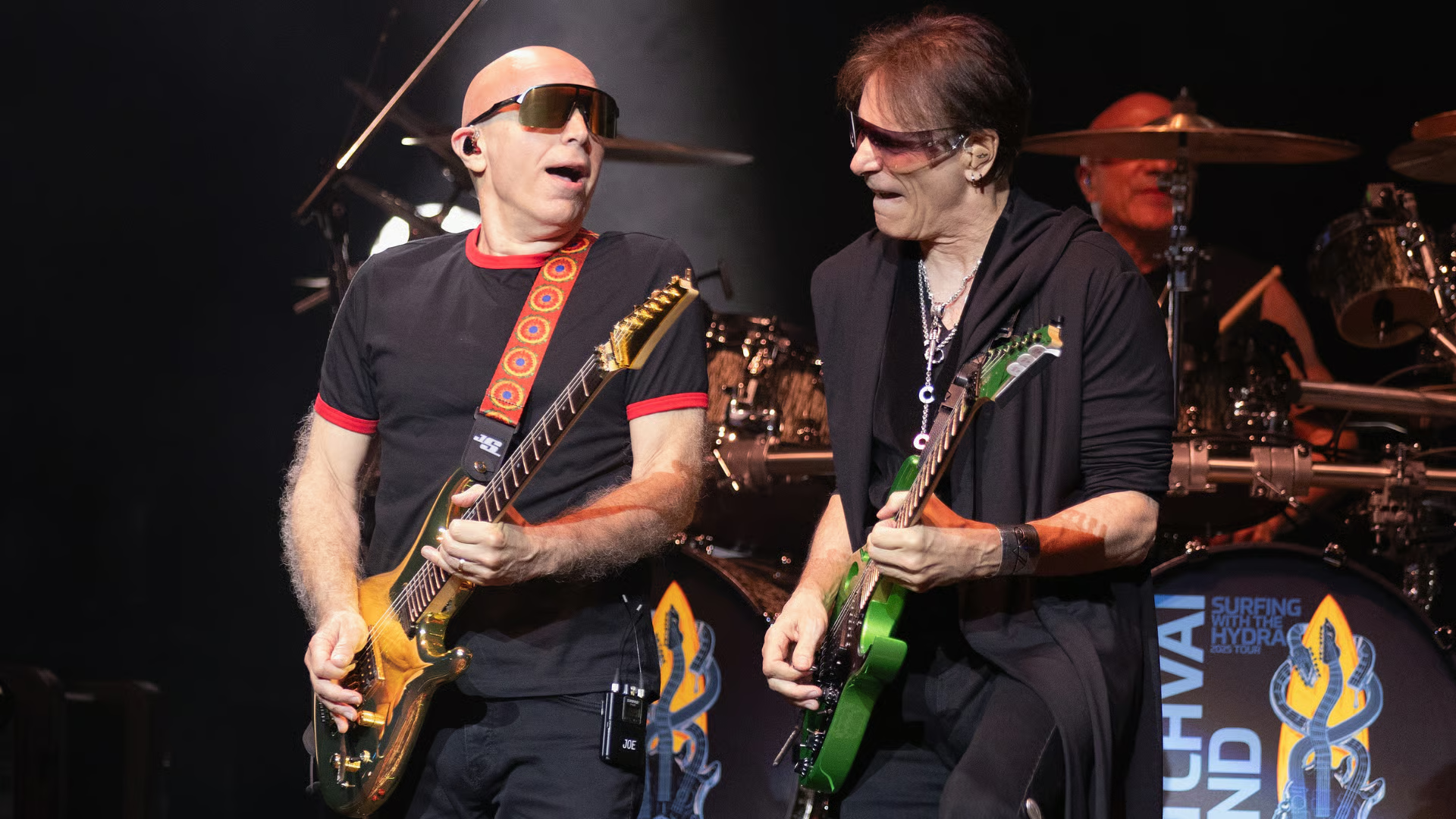
EARLIER this year, Steve Vai and Joe Satriani were on tour in Europe with the new SatchVai Band, while Satch also continues an arena tour with Sammy Hagar. Vai has also been touring with King Crimson-based band called Beat.
Somehow amongst their busy schedules, after five decades of intersecting careers, and lasting friendship, both have managed to finally achieve creating a debut joint album with the release The Sea of Emotion, and the results of their impressive, combined creativity are simply fantastic. We spoke to the one and only Mr. Vai shortly before a Beat show soundcheck.
HOT METAL: The album with Joe Satriani is great. Do you find that when you come into playing with him that the teacher and student dynamic starts again?
STEVE VAI: “Well, not the way it used to be, you know, but what I do usually feel that when I’m jamming with Joe is that the largest percentage of my focus is in listening, because that’s how you communicate. You’ve got to listen very intensely, and then there’s various ways of listening. One way of listening is creating and trading riffs, so you’ve got to really get into the other person’s psyche. So, that’s the language that we’re communicating is at the forefront, but always in the back of my mind, I’ve never really been able to kick that teacher and student dynamic. That’s because, you know, I was 12 years old when I started taking lessons with Joe, and he was our mentor back then: to all the kids in the town, and he was such a great teacher, and he was older. So, he was like a cool big kid, you know, three or four years older. But when you’re 12, that’s like another dimension, you know, and my whole focus in life at the time for two to three years was knowing my guitar lesson. You know, returning to my teacher and being able to get his approval on how I treated my lesson. I call that the ‘Vai advantage,’ because it was Joe Satriani, and even as a kid he was inspired. But then, of course, we became friends, and we grew our careers and everything. The teacher and student relationship was obviously in the past, but you create these neural connections that have legs and can carry you through your whole life. It served me very well to have almost like a mentor perspective on Joe. So, to answer your question, when we’re in the throes of an exchange, I do respect if there are opportunities where somebody needs to take a lead, even when we do interviews, you know, Joe answers first, and unless I’m asked, you know, so there’s always a respect and an appreciation that I inherited.”
HM: The last track “The Sea of Emotion Pt. 3 Reflections on a Year and a Half”, is based around a Sound on Sound tape recording, from back in your lessons. How did that inspire you?
SV: “Well, that was very interesting, because that was when I was probably 13, and I was playing the guitar for about a year and a half. I was taking lessons and Joe had this Sound on Sound tape recorder, with reels. I was so fascinated. I always loved that, and I didn’t know anything about it, but I was very interested in engineering. You know, as a result, I’ve produced and engineered all of my records, and I’ve always had a studio. But back then Joe had this little device and he broke it out during one of the lessons, and we just started jamming. He showed me this riff and we don’t even know who’s playing what, but we recorded about seven or eight minutes of these teenage kids plunking around. Then maybe a decade or so after that, Joe sent me the tape and I transferred it to digital and just kept it as a little treasure. But then when we started working on the record, the first two songs were ‘The Sea of Emotion Part One and Two’ and I received those from Joe before I started, you know, working on them. That inspired me to kind of do an outline for ‘The Sea of Emotion Part Three’. I thought how great would it be to start it with a little snippet of Joe and I as teenagers, and then take that riff, and flesh it out as a whole song. So, that’s a fun little Easter egg, as they’d say.”
HM: Oh indeed, but what I find fascinating about it is that even back then you both were getting your distinct sound.
SV: “Yeah, that’s right. Yeah, that’s how it works. When you’re young, you’re the most impressionable.”
HM: Is that what you like to educate kids about: to get their own signature sound?
SV: “Well, not necessarily because that’s going to happen anyway, you know, everybody’s DNA flows into how they touch notes. So, finding your own unique notes, you see, I always tell people to do what,…and it sounds so cliche, but do it where your heart is pulling you, to where your desires are pulling you. So, some people may think, ‘Oh my God, I got to find my own unique sound like Jeff Beck, or Eddie Van Halen,’ or all these guys that you know who they are when you hear one note, and that can be very intimidating for somebody that believes that that equals success. When in their heart, they’re saying, ‘Yeah, but I just really want to play Stevie Ray Vaughan’s songs and sound like him.’ So, my advice is if that’s what your heart is telling you, do that because if there’s a desire to find your totally unique, expression-able voice, you’ll know and you’ll find it.”
HM: How did you approach instrumentation this time around? There are so many options now, but the Hydra was probably not on the cards.
SV: “Yes, well, for the instrumentation itself, Joe and I decided we want real drums, we want real bass player, and we want real guitars, and that was the foundation. There are various accoutrements that come along with that, with most of them added by Eric Caudieux, our producer who was helping us through all this. But yeah, this is about guitar, and guitar, and guitar.”
HM: It is but whilst you’ve still got to make the music you create interesting for yourself, to some extent it also has to be commercially palatable. Is that an ongoing challenge?
SV: “Well, for some people, they naturally, and I say naturally, make music, that’s very accessible. But one of the great things about music is its diversity. It has diversity in tempos, colours, melody, dynamics and time signatures. It’s all around the world where I’ve studied this cultural music. Diversity in cultural music is extraordinary, and the same thing is true for guitar players or any musician.”
HM: How do you balance being still interested in the songs that you create, but at the same time allowing that accessibility?
SV: “Well, I think people try to balance commerce with their musical voice in various ways. Some people have no choice, they can only do what their creative instincts dictate, and this is the lucky person, I believe. That’s because what they create, as they’re creating it, there’s a lot of joy, there’s a lot of passion in it, and that flows into the music, and then the audience that they attract is the appropriate audience for them. But in the situation where you want to be, let’s say hypothetically, you want to be an instrumental guitar musician and you have great songs that you really love, in there. They fulfill your fantasy as a creator, you know. But something says, “Yeah, but you’re not going to sell any records, and you’re not going to be successful at this, and you’re not going to fit in, this isn’t what’s going on in the world right now. You need to make sure you sell records. So, listen to a bunch on the radio and listen to what’s popular, and pantomime that.’ Now, this is how many people, you know, many bands make their myth. It’s just an automatic thing that happens in the music business, in every business. In art, in everything. There’s an inspired person that comes along that just doesn’t have a choice. Do you think Jimi Hendrix had a choice? Or Prince had a choice? No, they’re going to be who they were, The End. So, the guys like that, then the music is filled with such an incredible dynamic. You know, it’s alive, and then as a result, there’s a huge contingent of people that are inspired by it, and want to do something just like it. So, that’s where they go, and those people are mostly dedicated to the commerce side. But every now and then somebody comes along that has no choice. Here’s what I might recommend to people suffering, or musicians suffering with that question: how do I balance commerce with my musical integrity? It’s difficult. You know, you hear guys like me say, ‘just do what you want. Don’t worry about it, you know, don’t try to be commercial. Just be you.’ What does that mean? So, here’s what I would say if you’re kind of on the fence and you don’t know where to go. Continue with the paranoia in creating the kind of music you believe other people will like from you. That’s fine but reserve a percentage of your time, 15 or 20 percent, or even five percent, whatever it is, to be brutally creative, and what I mean by that is no excuses: who are you? You have to ask yourself and experiment with this; I’m going to do something now. I don’t care about the world. Matter of fact, nobody’s going to hear it and nobody’s going to care about it, and so I can do whatever I want. This is just my little 15 percent asking, ‘who am I? Where can I allow my imagination to go?,’ and then just engage in that. Very interesting things can start happening. You’ll discover things about your own musical integrity that you didn’t know because in that 15 percent, there’s no fear of failure. You’ll always have your career to contemplate the fear of failure.”
HM: One could argue that a song like “Hina” from your David Lee Roth days would have been an option for doing a bit of that experimentation, given the panning of delay effects, and all that kind of thing. Is that correct?
SV: “Oh, yeah. See, I was so lucky because all those bands I played with, I was able to do what I wanted. But I worked within the framework of what the band was and I had rock and roll integrity. I loved rock and roll, and grew up on Led Zeppelin, Black Sabbath, Queen, Kiss, and Aerosmith. On the other hand, I was composing for orchestras, you know. Ha, so, my brain mixes it all together. “Hina” was a great opportunity because I just asked myself the question, “What can I do that I never heard Edward do?” and quite like that, because I wanted to offer Dave something different, you know. So, what can I do creatively with technology to create something that is a good rock song? But I like to be, I guess, cheeky and clever sometimes. I built that delay patch and I love it, that song. I love listening to it and how it turned out with the way the guitars work on each other with the delay. So, yeah, that was a situation where technology helped.”
HM: In that light, on this latest album, is there a particular track that you’re most proud of within that kind of context?
SV: “Well, there’s things that I really love, but for different reasons. For instance, there’s a song called “The Feeling I Know” and I just love how it came together because it just started out with a little chord thing that I had, that I sent to Joe and then he laid out some parts. He sent it back and I built on that, and I sent it back and then he chopped it up and built on it and so on. You know, we did that kind of thing and it just turned out for me, it just turned out so great as the melody is so lovely, but the guitar solos that we trade, they’re really, to me, the icing on the cake of Steve and Joe.”
HM: That’s the song where you’re on it leading the melody and then Joe’s echoing it.
SV: “Yeah, but there’s other things that are just so quirky and interesting, you know, like “Zoot Suit Riot”, the solos that we do in that are just crazy. I mean, it’s so fun to get an email from Joe with a new solo or something that he did because I just sit there and I go, ‘Oh my God, he did it again,’ you know.”
HM: Joe’s use of wah pedal as a filter, even going back to the DLRs days where to an extent, reminds of that talking guitar, because it’s such a vocal approach.
SV: “Yes, yeah.”
HM: Plus, when he’s playing slide, which is on “Bronco Freight Train”, it still has that feel.
SV: “Yeah. I absolutely agree, that’s one of my favorite solos on the whole record, Joe’s slide solo on “Bronco Freight Train”. There’s a lot of, as you might say, proud moments, I mean, the fact that we got it done, and that we’re both so happy with it and the process was so seamless and enjoyable and creative, you know, that is really the remarkable thing.”
HM: Yes, it is astounding, it’s a fantastic record. For “I Wanna Play My Guitar” you got Glenn Hughes as a guest. So The Sea of Emotion is not strictly an instrumental album.
SV: “No, because, you know, why I put up any barriers, is it really a rule? You know, for the whole record, Joe and I wanted to find a foundational inspiration, and so we chose the Sea of Emotion, which is this area that is like a 20 or 30 acres of open kind of space [from high school days, experiencing music without the distractions of tech and phones]. So, we’ve set our guitars and ourselves on that great 70’s music. So, “I Wanna Play My Guitar” was like the epitome of that time and place, where we were just these kids, and we’re so in love with the guitar, and playing in bands and doing this. Glenn Hughes was actually one of the artists we were listening to; it was just remarkable that, you know, 50 years later or whatever, here he is perfectly suited for this piece of music and able to sing it with no problem. I’ve worked with him in the past, but Joe had worked with him more extensively, so Joe reached out to him, and that’s how that happened.”


